
Il Servo e il Padrone
9.000,00 €
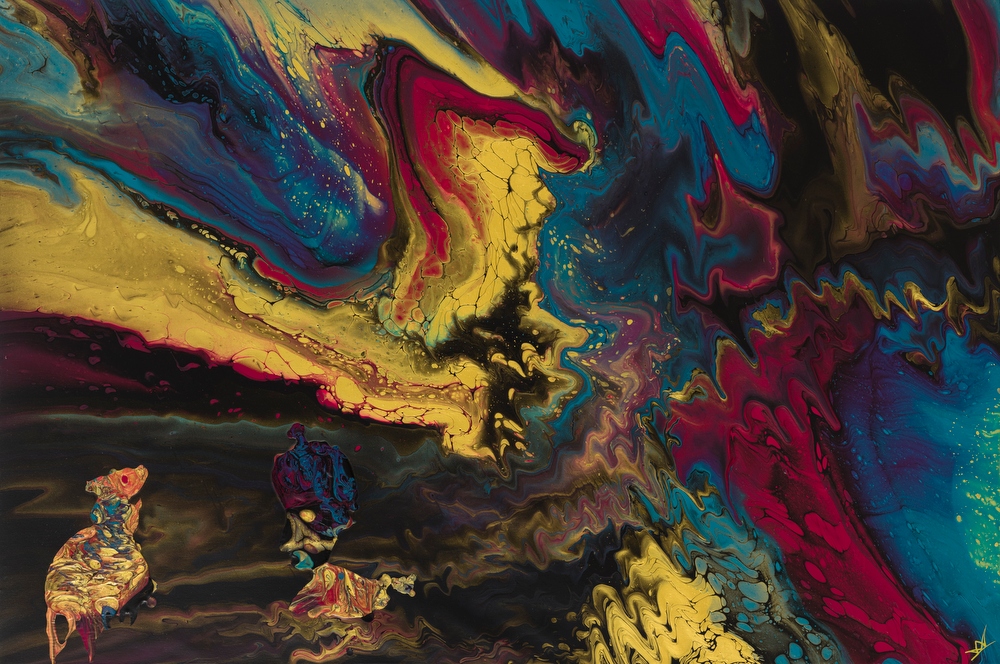
The fifth painting in the “ Smemagold” series is closely linked to the artist’s life. The master, with his own body, gives motion to the entire work. As a pure manifestation of power, he comes from above, travelling on a cloud. In turn, the servant is positioned below and observes the master’s arrival.
In this vertical hierarchy, in this relationship between high and low, the servant dissolves into colours and ends up losing his essence because of the act he has performed. The ancient master-servant dialectic is revived by introducing the technique of “pouring in pouring” or “pouring on pouring”. This is a process by which the artist extracts one or more subjects from abstract pourings derived from previous paintings. These elements are then placed on landscapes or backgrounds, giving movement to the work. They refer to thoughts, feelings, past memories and even scenes from everyday life. The result is a painting with a pouring base to which subjects from earlier phases are added.
Additional information
| Dimensions | 60 × 90 cm |
|---|---|
| Series | Smemagold |
| Date | 06-2020 |
| Technique | Acrylic Pouring on canvas |
Il quinto dipinto della serie "Smemagold" è strettamente legato alla vita dell'artista. Il maestro, con il proprio corpo, dà movimento all'intera opera. Come pura manifestazione di potere, viene dall'alto, viaggiando su una nuvola. A sua volta, il servo è posizionato in basso e osserva l'arrivo del padrone.
In questa gerarchia verticale, in questo rapporto tra alto e basso, il servo si dissolve nei colori e finisce per perdere la sua essenza a causa dell'atto che ha compiuto. L'antica dialettica padrone-servo viene ripresa introducendo la tecnica del "versare nel versare" o "versare sul versare". Si tratta di un processo con cui l'artista estrae uno o più soggetti da colate astratte derivate da dipinti precedenti. Questi elementi vengono poi collocati su paesaggi o sfondi, dando movimento all'opera. Si riferiscono a pensieri, sentimenti, ricordi passati e persino a scene di vita quotidiana. Il risultato è un dipinto con una base di colata a cui vengono aggiunti soggetti provenienti da fasi precedenti.